Canon Law Centre

Procurators and Advocates

(904) 712-0707
info@canonlawcentre.com

  • Home
  • About
  • Resources
    • 1983 Code of Canon Law (multilingual)
    • Pontifical Council for Legislative Texts
    • Glossary of Canonical Terms
    • Catholic Hierarchy
    • Index Canonicus
    • Official Responses from CDWDS
    • Canon Law Abstracts
    • Commentary on 1917 Code of Canon Law
    • CIC/17 Fontes
  • Contact

Jul 11

Motu Proprio on the Jurisdiction of the Juridical Authorities of Vatican City State in Criminal Matters

APOSTOLIC LETTER

ISSUED MOTU PROPRIO
OF THE SUPREME PONTIFF

FRANCIS

ON THE JURISDICTION OF THE

JUDICIAL AUTHORITIES OF VATICAN CITY STATE

IN CRIMINAL MATTERS

In our times, the common good is increasingly threatened by transnational organized crime, the improper use of the markets and of the economy, as well as by terrorism.

It is therefore necessary for the international community to adopt adequate legal instruments to prevent and counter criminal activities, by promoting international judicial cooperation on criminal matters.

In ratifying numerous international conventions in these areas, and acting also on behalf of Vatican City State, the Holy See has constantly maintained that such agreements are effective means to prevent criminal activities that threaten human dignity, the common good and peace.

With a view to renewing the Apostolic See’s commitment to cooperate to these ends, by means of this Apostolic Letter issued Motu Proprio, I establish that:

1. The competent Judicial Authorities of Vatican City State shall also exercise penal jurisdiction over:

a) crimes committed against the security, the fundamental interests or the patrimony of the Holy See;

b) crimes referred to:

– in Vatican City State Law No. VIII, of 11 July 2013, containing Supplementary Norms on Criminal Law Matters;

– in Vatican City State Law No. IX, of 11 July 2013, containing Amendments to the Criminal Code and the Criminal Procedure Code;

when such crimes are committed by the persons referred to in paragraph 3 below, in the exercise of their functions;

c) any other crime whose prosecution is required by an international agreement ratified by the Holy See, if the perpetrator is physically present in the territory of Vatican City State and has not been extradited.

2. The crimes referred to in paragraph 1 are to be judged pursuant to the criminal law in force in Vatican City State at the time of their commission, without prejudice to the general principles of the legal system on the temporal application of criminal laws.

3. For the purposes of Vatican criminal law, the following persons are deemed “public officials”:

a) members, officials and personnel of the various organs of the Roman Curia and of the Institutions connected to it.

b) papal legates and diplomatic personnel of the Holy See.

c) those persons who serve as representatives, managers or directors, as well as persons who even de facto manage or exercise control over the entities directly dependent on the Holy See and listed in the registry of canonical juridical persons kept by the Governorate of Vatican City State;

d) any other person holding an administrative or judicial mandate in the Holy See, permanent or temporary, paid or unpaid, irrespective of that person’s seniority.

4. The jurisdiction referred to in paragraph 1 comprises also the administrative liability of juridical persons arising from crimes, as regulated by Vatican City State laws.

5. When the same matters are prosecuted in other States, the provisions in force in Vatican City State on concurrent jurisdiction shall apply.

6. The content of article 23 of Law No. CXIX of 21 November 1987, which approves the Judicial Order of Vatican City State remains in force.

This I decide and establish, anything to the contrary notwithstanding.

I establish that this Apostolic Letter issued Motu Proprio will be promulgated by its publication in L’Osservatore Romano, entering into force on 1 September 2013.

Given in Rome, at the Apostolic Palace, on 11 July 2013, the first of my Pontificate.

FRANCISCUS
_________________________________


[Introduction: communiqué of the Holy See Press Office]

1. Today His Holiness Pope Francis has issued a Motu proprio on criminal law matters.

On this same date, the Pontifical Commission for Vatican City State has adopted the following laws:

– Law No. VIII containing Supplementary Norms on Criminal Law Matters;

– Law No. IX containing Amendments to the Criminal Code and the Criminal Procedure Code;

– Law No. X containing General Provisions on Administrative Sanctions.

2. The Motu proprio makes the criminal laws adopted by the Pontifical Commission for Vatican City State applicable also within the Holy See.

3. The criminal laws adopted today are a continuation of the efforts to update Vatican City State’s legal system, building upon the measures adopted since 2010 during the pontificate of Benedict XVI.

4. These laws, however, have a broader scope, since they incorporate into the Vatican legal system the provisions of numerous international conventions including: the four Geneva Conventions of 1949, on the conduct of war and war crimes; the 1965 Convention on the elimination of all forms of racial discrimination; the 1984 Convention against torture and other cruel, inhuman or degrading treatment or punishment, the 1989 Convention on the rights of the child and its optional protocols of 2000.

5. Of particular note in this context is the introduction of the crime of torture and a broader definition of the category of crimes against minors (including: the sale of children, child prostitution, the recruitment of children, sexual violence and sexual acts with children, and the production and possession of child pornography).

6. A section of the legislation introduces a list of crimes against humanity, in particular, the crimes of genocide and apartheid, following broadly the definitions adopted in the 1998 Statute of the International Criminal Court. The section of the Criminal Code regarding offences committed in the exercise of public administration has also been revised in light of the 2003 United Nations Convention against corruption. With regard to penalties, that of life imprisonment has been abolished and it has been replaced with a maximum penalty of 30 to 35 years of imprisonment.

7. In line with the most recent developments at the international level, the new legislation also introduces a system of penalties for juridical persons who profit from the criminal activities of their constituent bodies or personnel, establishing their direct liability and providing as penalties a set of interdictions and pecuniary sanctions.

8. In the area of criminal procedure, the general principles of presumption of innocence and due process within a reasonable time have been recognized explicitly, while the power of the judicial authorities to adopt precautionary measures has been increased by bringing up to date the provisions for confiscation and the freezing of assets.

9. Also of importance is the modernization of the rather dated norms governing international judicial cooperation, with the adoption of measures in line with the standards of the most recent international conventions.

10. The law on administrative sanctions is of a general nature so as to serve as a common framework that provides for the possibility of sanctions in different areas intended to promote respect for the norms, to render them effective and to protect the public interests.

11. As a whole, these normative efforts form part of broader process aimed at modernizing further the Vatican legal system with a view to enhancing its consistency and effectiveness.

_________________________________

[Presentation of the motu proprio by the Secretary for Relations with States Abp. Dominique Mamberti]

The laws approved by the Pontifical Commission for Vatican City State bring about a broad-ranging normative change, necessary for the function that this State, entirely

sui generis, is called upon to carry out for the benefit of the Apostolic See. The original and foundational aim of the Vatican, which consists of guaranteeing the freedom of the exercise of the Petrine ministry, indeed requires an institutional structure that, the limited dimensions of the territory notwithstanding, assumes a complexity in some respects similar to that of contemporary States.

Established by the Lateran Pacts of 1929, the State adopted the judicial, civil and penal structures of the Kingdom of Italy in their entirety, in the conviction that this would be sufficient to regulate the legal relationships within a State whose reason for existence lies in the support of the spiritual mission of Peter’s Successor. The original penal system – constituted by the Italian Penal Code on 30 June 1889 and the Italian Penal Code of 27 February 1913, in force from 7 June 1929 – has seen only marginal modifications and even the new law on sources of law (No. 71 of 1 October 2008) confirms the criminal legislation of 1929, while awaiting an overall redefinition of the discipline.

The most recently approved laws, while not constituting a radical reform of the penal system, revise some aspects and complete it in other areas, satisfying a number of requirements. On the one hand, these laws take up and develop the theme of the evolution of the Vatican judicial structure, continuing the action undertaken by Pope Benedict XVI in 2010 to prevent and combat money-laundering and the financing of terrorism. In this regard, the provisions contained in the 2000 United Nations Convention Against Transnational Organised Crime, the 1988 United Nations Convention Against Illicit Traffic in Narcotic Drugs and Psychotropic Substances, and the 1999 International Convention for the Suppression of Financing of Terrorism, are to be implemented, along with other conventions defining and specifying terrorist activity.

The new laws also introduce other forms of crime indicated in various international conventions already ratified by the Holy See in international contexts and which will now be implemented in domestic law. Among these conventions, the following are worthy of mention: the 1984 Convention Against Torture and Other Cruel, Inhuman or Degrading Treatment or Punishment, the 1965 International Convention on the Elimination of All Forms of Racial Discrimination, the 1989 International Convention on the Rights of the Child and the 2000 Optional Protocols, the 1949 Geneva Conventions on War Crimes, etc. A separate section is dedicated to crimes against humanity, including genocide and other crimes defined by international common law, along the lines of the 1998 Rome Statute of the International Criminal Court. From a substantial point of view, finally, further items of note are the revision of crimes against the public administration, in line with the provisions included in the 2003 United Nations Convention Against Corruption, as well as the abolition of the life sentence, to be substituted by a maximum custodial sentence of 30 to 35 years.

While many of the specific criminal offences included in these laws are undeniably new, it would however be incorrect to assume that the forms of conduct thereby sanctioned were previously licit. These were indeed punished, but as broader, more generic forms of criminal activity. The introduction of the new regulations is useful to define the specific cases with greater certainty and precision and to thus satisfy the international parameters, calibrating the sanctions to the specific gravity of the case.

Some of the new categories of criminal activity introduced (for instance, crimes against the security of air or maritime navigation or against the security of airports or fixed platforms) may appear excessive considering the geographic characteristics of Vatican City State. However, such regulations have on the one hand the function of ensuring respect for international anti-terrorism parameters, and on the other, they are necessary to ensure compatibility with the condition of so-called “dual criminality”, to enable the extradition of persons charged or convicted of crimes committed abroad should they seek refuge in Vatican City State.

Special emphasis is given to the discipline of “civil responsibility of juridical persons derived from a criminal violation” (arts. 46-51 of the law containing complementary regulations on criminal matters), introducing sanctions for juridical persons involved in criminal activities as defined by the current international legal framework. To this end an attempt has been made to reconcile the traditionally cautious approach observable also in the canonical order, according to which “societas puniri non potest” with the need, ever more evident in the international context, to establish adequate and deterrent penalties also against juridical persons who profit from crime. The solution adopted was therefore that of establishing administrative responsibility of juridical persons, obviously when it is possible to demonstrate that a crime was committed in the interests of or to the advantage of that same juridical person.

Significant modifications are introduced also in terms of procedure. These include: updates in the discipline of requisition, strengthened by measures regarding the preventative freezing of assets; an explicit statement of the principles of fair trial within a reasonable time limit and with the presumption of innocence; the reformulation of regulations regarding international judicial cooperation with the adoption of the measures established by the most recent international conventions.

From a technical and regulatory point of view, the plurality of sources available to experts was organised by means of their combination in a harmonious and coherent body of legislation which, in the frameworks of the Church’s magisterium and the juridical-canonical tradition, the principal source of Vatican law (Art. 1, Para. 1, Law No. 71 on the sources of law, 1 October 2008) takes into account simultaneously the norms established by international conventions and the Italian juridical tradition, reference to which has always been made by the Vatican legal order.

In order to better order a legislative work with such broad-ranging content, it has been drafted as two distinct laws. One brings together all the legislation consisting of modifications to the penal code and the code of criminal procedure; the other will instead consist of legislation of a nature which does not permit a homogeneous section within the code structure and is therefore gathered in form of a later or complementary penal code.

Finally, the penal reform hitherto presented is completed with the adoption by the Holy Father Francis of a specific Motu proprio, also bearing yesterday’s date, which extends the reach of the legislation contained in these criminal laws to the members, officials and employees of the various bodies of the Roman Curia, connected Institutions, bodies subordinate to the Holy See and canonical juridical persons, as well as pontifical legates and diplomatic staff of the Holy See. This extension has the aim of making the crimes included in these laws indictable by the judicial organs of Vatican City State even when committed outside the borders of the state.

Among the laws adopted yesterday by the Pontifical Commission for Vatican City State there is also the law consisting of general legislation on the subject of administrative sanctions. This law had already been proposed in Art. 7, Paragraph 4 of Law 71 on the sources of law of 1 October 2008, and establishes the general principles and regulation of the application of administrative sanctions.

For some time there has long been an awareness of the expedience of an intermediate tertium genus between penal and civil offences, also in relation to the growing relevance of administrative offences. As a discipline of principle, the provisions of such a law would be used whenever another law establishes the imposition of administrative penalties for a breach of law, no doubt to specify the procedure for their application to the competent authority and the order of other minor effects.

One of the cornerstones of the system introduced by this law is constituted by the so-called rule of law, as a result of which administrative sanctions may be imposed only in cases defined by law. The procedure for implementation is divided into a phase of investigation and challenge of the infringement by the competent offices, and a second phase of imposition of the sanction, which will fall within the competences of the President of the Governorate. Finally, there will be the right to appeal heard by a single judge except in more cases of more severe penalties, for which the jurisdiction of the Court is established.

To conclude this brief presentation, it may be observed that the laws indicated above are notable not only for their undeniable substantial and systematic relevance, but also because they represent a further significant step on the part of the Vatican legislator towards the refinement of its legal code, necessary to assume and promote the constructive and useful proposals of the international Community with a view to more intense international cooperation and a more effective pursuit of the common good.
 

Post in: CLC Blog

Apr 22

The Notion of Crime in Canon Law

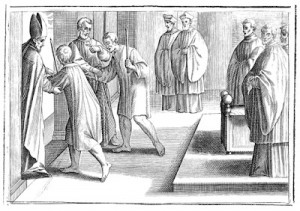
bishop and sinner

“A crime, in ecclesiastical law, is an external and morally imputable transgression of a law to which is attached a canonical sanction, at least in general.  It is the law, either eternal or positive, that governs order, the relation of man to God and of man to man, and any defection from that order constitutes a frustration of the designs of Providence. But the transgression which the ecclesiastical law considers is not merely the guilty mind (mens rea), but the act, an outward manifestation of a vicious intention, or a breach of the law as externally apprehensible. . . A transgression of the law is an act, and the transgressor, therefore, is an agent, and when that agent is intelligent and free, and acts as such, we say that the effects caused by such an agent are to be imputed or credited to him.”  (Rev. Charles Augustine, O.S.B., Commentary on the New Code of Canon Law, Vol. VIII, Bk. V)

Post in: CLC Blog

Apr 18

FAQ on the Canonical Process for the Resolution of Allegations of Sexual Abuse of Minors by Priests and Deacons

Q: Does the Church have its own laws against the sexual abuse of minors by members of
the clergy?

A: Yes, the Church has long had laws on the books that address this crime. Even before the
majority of the Church laws were collected into a single code of laws (in 1917 and in 1983), sins
against the Sixth Commandment with a minor were also considered criminal acts. From 1917
onwards, the Church promulgated concise legal norms that stated this and that imposed penalties
on clergy that offended in this terrible way.

Q: Which Church authority is responsible for addressing these offenses?
A: In April 2001, Pope John Paul II issued a law stating that, from then on, the Congregation for
the Doctrine of the Faith (CDF) in Rome, headed at the time by Cardinal Ratzinger, the future
Pope Benedict XVI, would have sole Church authority over this crime. The Congregation for the
Doctrine of the Faith is one of the offices that assist the Pope in fulfilling his mission as Supreme
Pastor of the Catholic Church. Prior to 2001, the crime was generally to be dealt with on the
local level by the diocesan bishop. The CDF would have been involved if the offense had
occurred on the occasion of the celebration of the Sacrament of Penance (confession). Otherwise,
the case would have gone for a second hearing (appeal from the diocese) to the Congregation for
Clergy or the Tribunal of the Roman Rota, offices that assist the Pope, depending on how the
allegation had been resolved on the local level.

Q: What does canon law now require a bishop to do when he receives an allegation of
sexual abuse of a minor committed by a cleric (priest or deacon)?

A: The Code of Canon Law stipulates that the first steps after receipt of an allegation of the
commission of an ecclesiastical crime are usually taken by the local bishop. If the priest against
whom an allegation is brought is a member of a religious order, his superior might take the first
steps instead. Any allegation that has the semblance of truth (it is not manifestly false or
frivolous) undergoes what is referred to as a preliminary investigation. During the preliminary
investigation, the accused enjoys the presumption of innocence and his good name must not be
illegitimately harmed. According to the Essential Norms, which constitute law on sexual abuse
of minors for the dioceses of the United States, the investigation should be conducted promptly
and objectively. The Essential Norms also require the bishop to follow all civil reporting laws
when the allegation concerns the sexual abuse of minors. Church officials are also to cooperate
with civil authorities in their own investigations. Moreover, the bishop exercises his power of
governance in other ways to make sure no harm comes to children during the phase of the
preliminary investigation.

Q: Does the Holy See become involved at this point?
A: Usually not. The Congregation for the Doctrine of the Faith does have sole competence in
resolving allegations of sexual abuse of minors committed by clerics. But this competence does not yet “kick in.” The Congregation exercises its authority once a case is referred to it by the
local bishop. The bishop makes the decision as to whether a case will be referred. In most
instances, unless the allegation proves manifestly false, it must be reported to the Congregation.
The Essential Norms require a bishop to report all cases to the CDF once he has sufficient
evidence that the sexual abuse of a minor may have occurred. The Congregation would normally
have knowledge of the accusation only when it is reported to the Congregation by the bishop or
religious superior.

Q: How does the preliminary investigation into the allegation take place?
A: The bishop appoints an investigator. The investigator has the obligation and authority to
collect the facts and circumstances surrounding the allegation so that the bishop can make a
determination about its truthfulness and what further action he would recommend to the
Congregation for the Doctrine of the Faith. The investigator often uses the expert services of
others to assist with the investigation. In the United States, the bishop also makes use of the
services of his Diocesan Review Board, a panel of experts, to help him review the allegation and
associated information. The bishop and investigator are careful not to interfere with any civil
investigation into the accusation that might take place. The investigator and others who assist in
the investigation may be laypersons.

Q: Does the bishop always report the case to the Congregation for the Doctrine of the
Faith?

A: The general rule is that all cases are referred to the Congregation. The exception, as noted
above, would be when the allegation is manifestly false. In other words, if there is any semblance
of truth at all to the allegation, the bishop seeks the intervention of the Congregation. If he is in
doubt about the semblance of truth, he may seek the assistance of the Congregation to assist him
in coming to a decision.

Q: What happens after the bishop reports the results of the preliminary investigation to the
CDF?

A: The CDF will review the material and make a decision on what the next steps might be. The
decision is based on the material gathered during the investigation and on the observations and
recommendations of the bishop regarding the allegation and what might be a suitable way to
address it. The next steps could include several options depending on what materials the CDF
received. Among them, the CDF could authorize the bishop to hold a trial locally or to address
the allegation through a simplified, administrative penal process. It could also hold a trial in
Rome at the offices of the CDF. In the clearest and most egregious cases, the CDF could refer
the matter to the Pope for immediate dismissal of the cleric (see below for more on this). It might
also happen that more information is needed before a decision can be made. This would require
the bishop to gather the information and forward it to the CDF. The CDF could also confirm, if
the facts and circumstances warranted it, that there is not sufficient evidence of the commission
of an ecclesiastical crime.Q: Is the priest or deacon still in ministry while all of this is being considered?
A: No. A bishop may at any time withdraw a cleric from active ministry pending the outcome of
an investigation of the allegation. This is done primarily to assure that children are not in danger
should it prove true that the cleric had committed acts of abuse. At the same time, it must be
emphasized again that the cleric enjoys the presumption of innocence. This should be made clear
by the diocese to the public. If the allegation is unfounded, the bishop must strive to repair any
illegitimate damage to the good reputation of the priest or deacon.

Q: Does the Pope become involved in the consideration of how best to proceed with
addressing an allegation?

A: No. The CDF handles these cases. The Pope does not supervise the daily activities of the
Congregation nor become involved in particular cases as they are being processed.

Q: What does a sexual abuse trial look like when conducted under canon law?
A: It is similar to criminal trials that take place in some European countries that follow a
different legal tradition than that of the United States. Because of this, the canon law trial will
not appear similar to those we might be familiar with in the United States. A panel of three
judges hears the case. The accused has a canon lawyer to assist in his defense. The prosecutor is
referred to as the “promoter of justice.” Tribunals in both a diocese and the CDF have promoters
of justice. Witnesses are called to testify, including possible victims. The judges, rather than the
canon lawyers, question the witnesses. Other forms of evidence are gathered, such as letters that
might have been written. After this the defense canon lawyer and promoter of justice submit
written arguments of their sides of the case. The judges then review the evidence carefully,
deliberate together, and issue a verdict. If the finding is for guilt, the judges also impose a
penalty (see below for types of Church penalties).

Q: Is the verdict open to appeal?
A: Yes. Once the tribunal issues its decision, the decision goes to the CDF. Both the verdict
(whether for or against guilt) and penalty (if the verdict for guilt) may be appealed by either the
accused or the promoter of justice of either the diocese or the CDF. If no appeal is lodged within
a certain time frame, the sentence is final. If an appeal is lodged, another hearing of the case will
take place by an appellate panel of judges. This may occur again at the CDF, or, with
authorization of the CDF, at the local level.

Q: Does the Pope have a role in hearing the appeal?
A: No. The CDF has its own supreme tribunal. The Pope himself does not sit personally as a
judge on the tribunal of the CDF. He has several judicial courts or tribunals that administer
justice, one of which is the CDF tribunal. The decision of the CDF in an appeal of a judicial
sentence is final.

Q: Is a formal trial the only way that allegations of this crime can be resolved as a matter
of canon law?

A: No. In cases where the evidence of the possible commission of sexual abuse is stronger, the
CDF might authorize what is called an administrative penal process. Here, unlike a judicial trial,
the bishop himself makes the decision regarding the charges brought against the accused. He
considers the evidence with the help of two persons called assessors. They are expert in canon
law or some other discipline necessary for a thorough evaluation of the evidence. The accused
also has the opportunity to offer a defense. The bishop then issues a decree with his decision and
suggested penalty (if he finds for guilt). This decree is sent to the CDF for confirmation. The
accused has the right to seek reconsideration of the outcome.

Q: What Church penalty can be imposed for the crime of sexual abuse of minors?
A: Catholic Church law provides a range of penalties for various crimes. For the sexual abuse of
minors it provides for a just penalty that may include dismissal from the clerical state. In any
event, according to the Essential Norms, in every case where a cleric admits to or is found guilty
of the sexual abuse of minors he is permanently withdrawn from all public ministry. Nor may he
present himself as a priest or deacon. Thus, even if a member of the clergy is not dismissed from
the clerical state for having committed the crime of the sexual abuse of minors, his public
ministry is still fully restricted in light of the gravity of the offense committed.

Q: What does dismissal from the clerical state mean for the priest or deacon?
A: The legal status of the priest or deacon changes. He now has the status of a lay person, not a
cleric. He also has other restrictions placed on him that might not apply to other lay persons. So,
for instance, a priest dismissed from the clerical state may no longer exercise priestly ministry,
including saying Mass, present himself as a priest, use the title “Father” or “Reverend”, hold
pastoral and teaching positions in the Church, and receive the income he did as a cleric.

Q: Does the CDF ever ask the Pope to impose a penalty?
A: Yes, in a very small subset of cases, where the guilt of the cleric is beyond doubt. This might
occur, for instance, when the priest himself has confessed to this or been found guilty of the
crime in a civil court of law. In the gravest cases, the CDF may request that the Pope dismiss the
cleric “ex officio;” that is, without a first holding a trial or conducting another type of formal
legal process. In such cases, the Pope himself issues a decree dismissing the priest or deacon
from the clerical state. There is no appeal of this decision by the cleric.

Q: Is dismissal from the clerical state the same thing as what is commonly called
“laicization”?

A: Dismissal from the clerical state is a permanent penalty imposed in response to the
commission of an ecclesiastical crime. A priest or deacon can also lose the clerical state
voluntarily by requesting it of his own accord from the Holy See. This is what is often called
“laicization” in common parlance, but which more properly should be referred to as a dispensation from the obligations of the clerical state. The priest or deacon is no longer counted as a cleric, but now has a different legal status in the Church. Among the consequences of his new status is the fact that is not able to function as a priest or deacon or to present himself as one publically.

Q: How does dismissal from the clerical state differ from what is called “suspension”?
A: Suspension of a member of the clergy is also a penalty imposed for violation of a criminal
law. The effects of it are similar to dismissal from the clerical state inasmuch as the priest or
deacon is not permitted to function in public ministry. However, suspension does not remove the
cleric from the clerical state. He remains a member of the clergy even if he is not exercising any
functions associated with it. Additionally, whereas dismissal is a permanent penalty, suspension
is not. It is imposed so long as the reasons for its imposition remain. To offer one example, if a
priest is suspended due to illegitimate behavior with a minor, the suspension remains in force,
but would be lifted if the allegations are withdrawn or proven false.

Q: Some priests have been assigned to what is called a “life of prayer and penance.” What
does this mean?

A: The Essential Norms recognize that there might be cases where a priest or deacon has either
admitted to a past act of abuse or has been found guilty of one, but dismissal from the clerical
state does not occur. This could happen, for instance, when a priest is seriously ill or of advanced
age. So a life of prayer and penance is imposed on the priest instead. In these cases, too, he is
forbidden from all public ministry and from otherwise presenting himself as a priest. He is
expected to dedicate his life to praying for victims and repenting of his past offenses. In this way,
the Church seeks even here to prevent any future abuse and to repair the injustice that has
already taken place.

Q: If a legal process does not result in the imposition of a penalty, does that mean the priest
or deacon will return to public ministry?

A: The presumption is that the cleric will be returned to ministry if he is not found guilty.
However, the answer to this question depends on several factors that are particular to each case.
It might turn out that even though a priest or deacon is not proven to have abused minors, other
issues surrounding his ministry or behavior might have arisen during the investigation that cause
concern for the bishop. This might involve, for instance, unacceptable boundary violations or
improper behavior with adults. These situations would need to be addressed before the priest or
deacon is returned to public ministry.

Q: Are there cases where a priest or deacon is falsely accused of sexual abuse?
A: Yes. As with all accusations brought to authorities, not all of them turn out to be true. In all
cases, a thorough investigation is made to ascertain the truth of the allegation. The rights of
everyone must be respected during this phase. If this process determines that the accusation was
false, the good reputation of the cleric needs to be repaired. The Essential Norms state that every step possible must be made to restore the good name of those who have been falsely accused and
whose good reputation might have been illegitimately harmed.

Q: Does the Church conduct the legal proceedings mentioned above in secret?
A: The word “secret” is a literal translation of the Latin word “secretum.” The better translation
would be “confidential.” Church law does require that formal trials and other processes that lead
to the imposition of penalties be dealt with confidentially. This is meant to protect the accused,
the witnesses, and the integrity of the Church process. For instance, general members of the
public are not admitted to the court proceedings. Although these proceedings are confidential,
that does not forbid or even discourage anyone from reporting the underlying allegations to civil
authorities. In fact, the opposite is true when it comes to the sexual abuse of minors. The
Essential Norms strictly mandate that bishops will follow civil reporting laws, and that they
advise a person of his or her right to make a report to public authorities and support the person in
doing so.

The above FAQ is taken from the USCCB website, the full text of which can be accessed here

Post in: CLC Blog

Blog Archive

  • September 2015 (1)
  • January 2015 (1)
  • July 2013 (1)
  • June 2013 (1)
  • April 2013 (3)
  • July 2012 (2)
  • June 2012 (1)
  • May 2012 (1)
    © 2025 Canon Law Centre, LLC
    All rights reserved.

    Canon Law Centre, LLC
    411 Walnut Street
    Suite 14306
    Green Cove Springs, FL 32043

    Cleantalk Pixel